Attached homes, meaning condos and townhomes, still cost less than detached houses. That part has not changed. What has changed is that they are no longer keeping pace on price, and the gap is widening rather than closing. If you own one, or you are weighing one as a first purchase, the reason this is happening matters more than the headline number, because it is structural and it is not likely to reverse quickly.
Two markets wearing one label
County median figures blend everything together and hide what is actually going on. Split the market by property type and the divergence is clear. As of the spring 2026 county data, detached single family homes carried a median around $1.1 million and were running roughly flat to modestly higher than a year earlier. Attached condos and townhomes sat near $675,000 and were down on the year, in the range of one and a half to a bit over two percent depending on the source and month. One monthly read put single family price growth at about 1.9 percent year over year while the median townhome price fell about 5 percent and the median condo fell close to 2 percent over the same span.
None of these are crash numbers. That is the point. This is not a condo market falling apart. It is a detached market holding firm while the attached market slips, and two segments moving in opposite directions on price is the definition of a market that has split in two while still reporting under one countywide median.
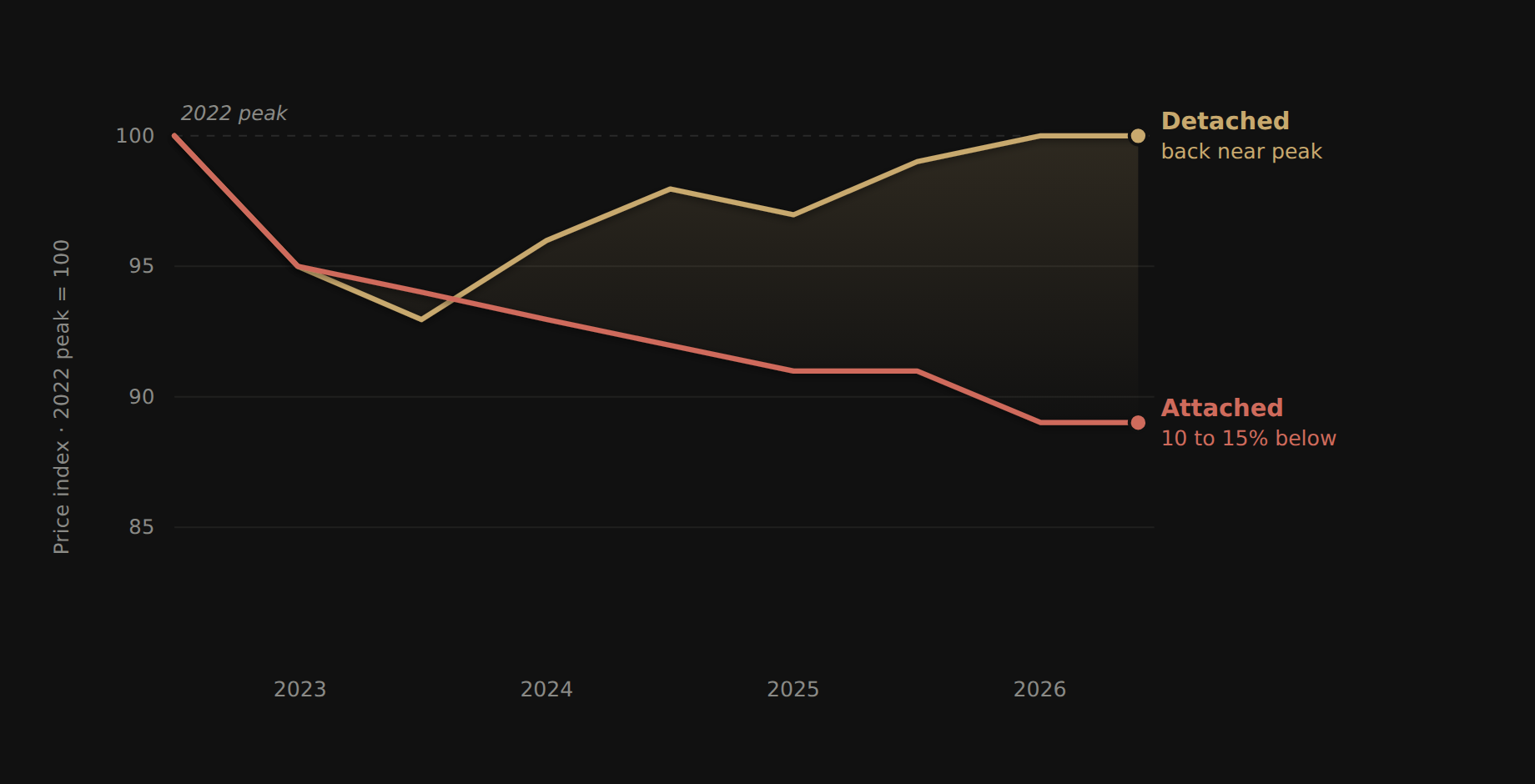
Both segments fell after 2022. Detached climbed back to near its peak while attached homes never recovered and sit roughly 10 to 15 percent below it. Path is illustrative and anchored to reported endpoints, not a precise index. Source: San Diego brokerage market reports, 2026.
Why the split, in supply terms
The cleanest way to understand this is through supply, and here my day job trading fixed income is useful, because this is a supply and demand story before it is a real estate story.
Start with the lock in effect. A large share of San Diego owners financed or refinanced at rates between roughly 2.5 and 3.5 percent in 2020 and 2021. With current rates in the mid 6 percent range, selling and rebuying means trading a 3 percent cost of capital for something more than double it, which can add well over a thousand dollars a month to the payment on a comparable move. Most of those owners are detached homeowners, and most of them are staying put. That keeps detached inventory scarce, and scarce supply holds prices up even when demand is only steady.
The attached segment has the opposite supply picture. Condo and townhome inventory has been building, not shrinking, and when supply grows while buyers stay selective, price gains stall and days on market lengthen. Recent county data showed detached inventory down sharply from a year earlier while attached inventory rose over the same period, with attached homes also taking meaningfully longer to sell. Same county, same month, two supply curves pointing in opposite directions, and price followed each one where you would expect.
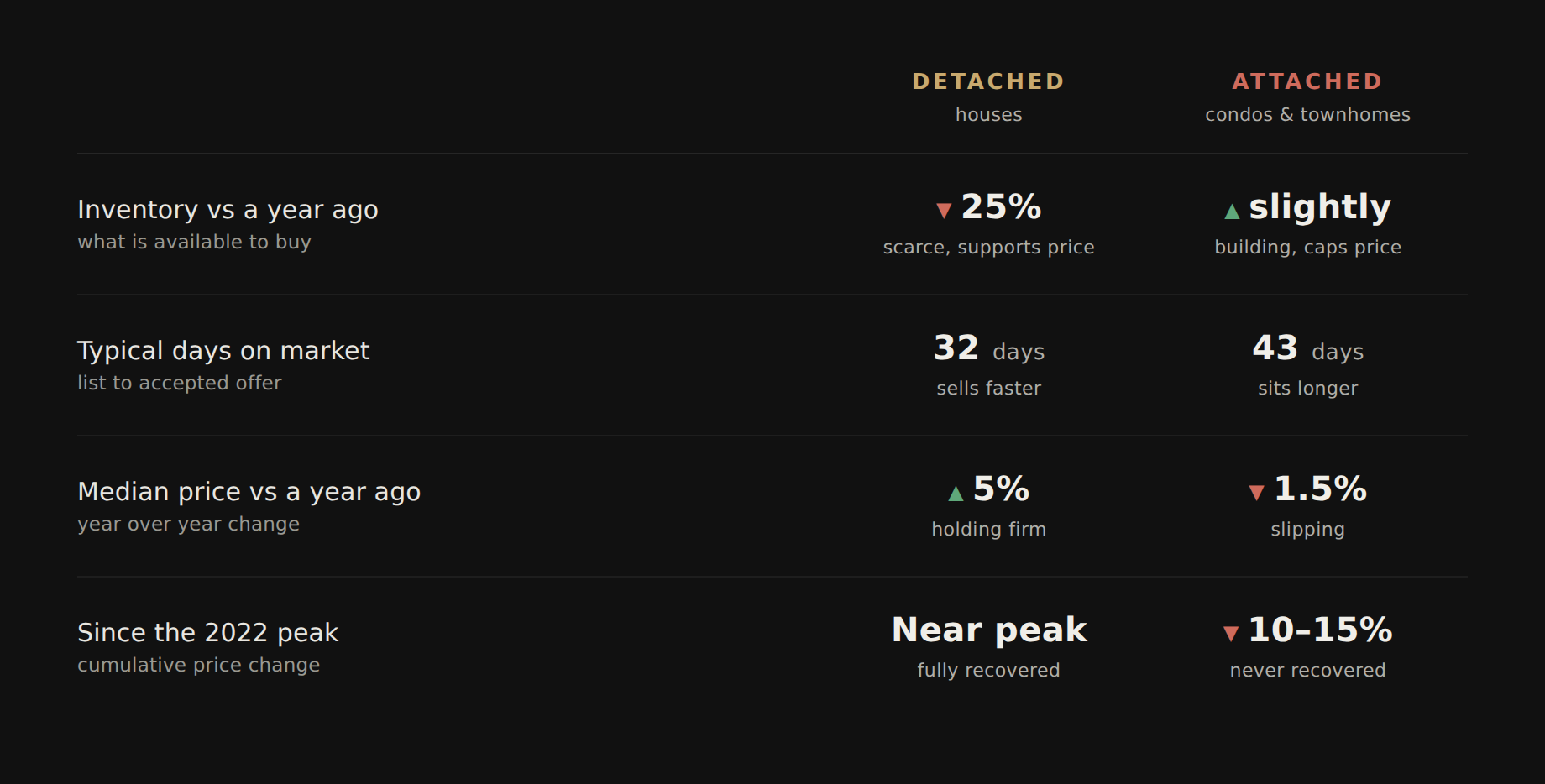
Four metrics, same county, opposite readings. Scarce detached supply and quick sales support price; growing attached supply and longer market times soften it. Source: Greater San Diego Association of Realtors and San Diego brokerage market reports, 2026.
Then there is cost of carry, which is where attached ownership has gotten genuinely more expensive to hold. Rising HOA dues, new state mandated inspection requirements for multi story attached buildings, higher insurance premiums, and in some buildings special assessments for deferred maintenance have all pushed up the true monthly cost of owning a condo. Every dollar of higher carrying cost is a dollar a future buyer cannot put toward price, so those costs come directly out of what the home can sell for. The affordable entry point is still cheaper to buy, but it is no longer as cheap to own, and that erosion shows up in resale value.
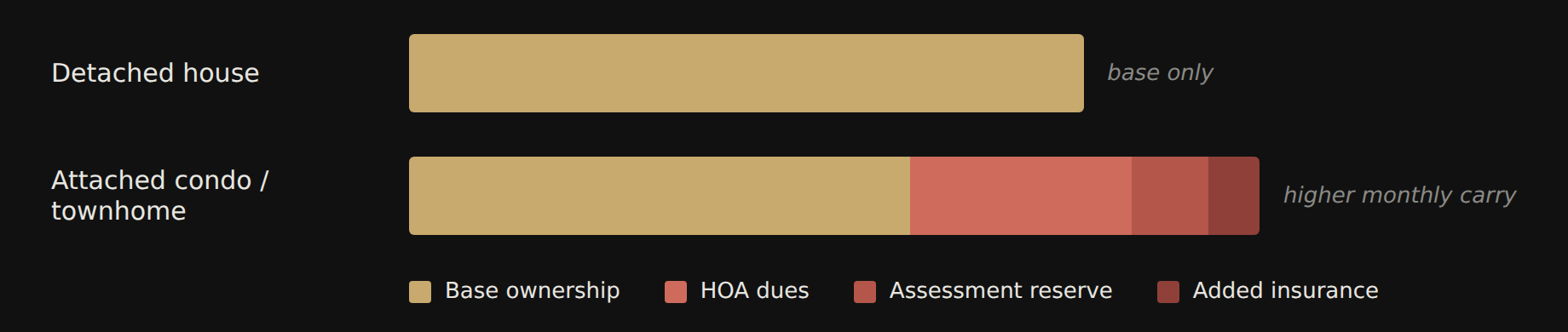
The lower purchase price is real, but HOA dues, assessment reserves, and higher insurance raise the monthly carry on an attached home, and a buyer prices that in. Proportions are illustrative and vary by building. Source: California Association of Realtors and San Diego brokerage commentary, 2026.
The mechanism in one line. Scarce detached supply props detached prices up, growing attached supply caps attached prices, and rising HOA, insurance, and assessment costs pull attached resale values down from a second direction. Two segments, opposite forces, one blended county median that hides both.
What this means if you own or are buying
For owners, the honest read is that a condo or townhome bought in the last several years has most likely appreciated less than a detached home bought at the same time, and possibly given back some ground over the past year. That is disappointing if you expected the two to move together, but it is not a reason to sell into a soft segment on emotion. It is a reason to price realistically if you do sell, because the days of a condo carrying momentum on its own are not the current market. A well priced attached home still sells. One priced off detached style comps from 2024 sits and then chases the market down.
For buyers, the takeaway is not that condos and townhomes are a bad decision. It is that they are increasingly a lifestyle and cash flow decision rather than an appreciation play. If a condo gets you into a neighborhood you want, at a payment you can carry, with amenities and a lock and leave lifestyle you value, those are real reasons to buy one. Just underwrite it for what it is. Assume slower price growth than a detached home, budget honestly for HOA increases and the possibility of an assessment, and do not count on appreciation to bail out a stretch purchase.
The setup from here
Reading the setup rather than forecasting a number, the forces behind this divergence are not the kind that resolve in a quarter. The lock in effect persists as long as there is a wide gap between the rates owners hold and the rates on offer, and that gap closes slowly. The cost pressures on attached buildings, insurance, inspections, and assessments, are structural and mostly moving one direction. That points toward the detached and attached segments continuing to behave like two different markets for a while, with detached better supported on price and attached more sensitive to inventory and carrying cost.
The variable to watch is rates. If mortgage rates fall far enough to loosen the lock in effect, some of this could narrow, because more detached supply would come to market and relieve the scarcity holding that side up. That is a possibility in the setup, not a base case to bank a purchase on. Plan around the market you have, not the one a rate cut might deliver.
If you own an attached home and want to understand where yours specifically stands, or you are deciding between attached and detached for a purchase, the county median will not answer it and neither will a portal estimate. The answer is in comparable sales for your building and your segment, and I am glad to walk through those numbers with you.