How I sold 3835 Elijah Court in three days.
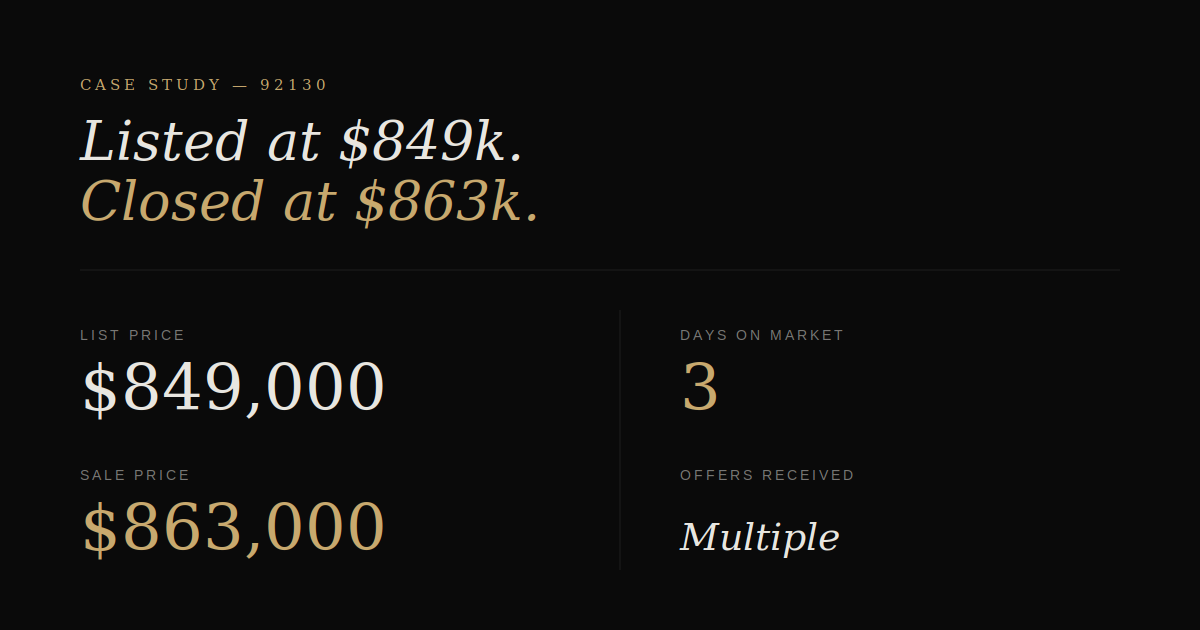
Listed at $849,000. Closed at $863,000. Multiple offers in three days. Here is the full playbook, because the number on the contract is the easy part. The strategy that got us there is the part that matters.
The setup
The listing was a 1,193 square foot, two bedroom, two bathroom ground floor corner unit in the heart of Carmel Valley. Private garage immediately adjacent to the unit entrance. Southwest exposure. Split floor plan with dual primary suites. No Mello Roos. HOA covered water and trash.
It was also, to be direct, not the nicest unit in the complex. Other listings in the same building had more recent upgrades, fresher finishes, and more polished interiors. If the game was finishes, we were going to lose.
The game was never going to be about aesthetics.
The pricing thesis
Most sellers walk into a listing appointment wanting the highest possible list price. Most agents accommodate that instinct. It is the single most common mistake in residential real estate, and it is the reason so many homes sit on the market for 60 and 90 days before eventually closing below their original ask.
On Elijah Court, we did the opposite. We priced for velocity.
Price is not a wish. It is a mechanism for creating buyer competition. Set it correctly and the market does the work for you.
The thesis was simple. The unit had real structural advantages that could not be replicated by a renovation: ground floor access, corner privacy, a private garage steps from the door, no shared walls to the west, southwest light, dual primary suites, no Mello Roos. These are things you either have or you do not. No amount of quartz countertops in a competing unit changes them.
Price it at $849,000, position it as the best price per square foot in the building, and the structural buyers, those who value layout and privacy over finishes, would surface immediately. More than one of them, if we were right. And once there was more than one interested buyer on the same property at the same time, the market would do the rest.
What the rest of the market was doing
Context matters. This listing did not go live in a vacuum. Comparable units in the same building came to market in the weeks before ours at higher ask prices. Some remain active today. At least one has already taken a price reduction and is still sitting.
I mention this not to criticize other listings. Every seller and every agent makes the call they think is right with the information they have. I mention it because it illustrates the cost of the alternative approach. A unit that comes out aspirationally and then has to chase the market down is not just sitting longer. It is training the buyer pool to wait for further reductions, which makes every subsequent offer weaker than the one before it.
We priced to lead the market, not to chase it. The difference between those two strategies, measured on an identical floor plan in an identical building, is the difference between closing above ask in three days and taking a price cut after three weeks with no deal in sight.
The positioning
The listing copy made the thesis explicit. Unbeatable value. The most competitive price per square foot in 92130. Premium corner unit. No neighbors to the west. The residence was framed around what it had that nothing else in the complex had, not around what it did not.
This is the same discipline that governs a well constructed fixed income trade. You do not pitch what a bond is missing. You pitch what it has that the rest of the curve does not. Elijah Court had a genuinely differentiated structure. The job was to make sure the market saw it.
The execution
We held one open house the first weekend. The pricing did what it was supposed to do. Traffic was heavy. Multiple offers materialized within the first three days. We took the market's response, negotiated position against position, and closed at $863,000.
The spread between list and close, $14,000 over ask, is not the headline number to me. The headline number is three days on market in a 92130 environment where the average sit time runs above 30 days. That is the difference between a strategy that worked and a listing that sat.
What this tells sellers about the spring 92130 market
The conventional read on the current market is cautious. Median prices are technically down year over year. Days on market have stretched. Mortgage rates are holding above 6 percent. Headlines are not friendly.
The data on the ground is more nuanced than the headlines. Buyers with conviction are still out there, and in 92130 specifically they are still willing to compete when a property is priced correctly and positioned against its genuine strengths. What is not working right now is aspirational pricing. Listings that come out at the top of the range expecting buyers to stretch are the ones sitting 45 and 60 days before capitulating.
The spring window in 92130 is open. It is not generous, and it does not reward wishful thinking. It rewards sellers who approach their listing the way a disciplined investor approaches a position. Know what you own. Know what it is worth. Price it for the outcome you actually want.
The takeaway
One sale is not a market. I am not going to pretend this playbook is a rule. It is a data point, and the honest thing to say about one data point is that it is one data point.
What I will say is that the framework is repeatable. Identify the structural advantages a property has that cannot be replicated. Position around them. Price for velocity, not for ego. Let competition do the work that nagging the market will not.
That is the entire playbook. It is not glamorous. It is not complicated. It just requires the discipline to resist the most common instinct in real estate, which is to ask for more than the market will give you and then spend the next two months apologizing for it.
Thinking about selling in Carmel Valley?
Let's talk about what your home is actually worth, and how to price it so it moves.
Schedule a strategy session